Physics
Why study Physics at The Perse?
Physics at The Perse is about understanding the fundamental principles that govern the material world. From the smallest particles to the largest structures in the universe, pupils learn to think deeply about how things work, developing the analytical skills, mathematical confidence and intellectual curiosity needed to tackle complex problems. As the most fundamental of the sciences, Physics provides an invaluable foundation for a wide range of careers, from engineering and technology to medicine, finance and scientific research.
Learning how to think
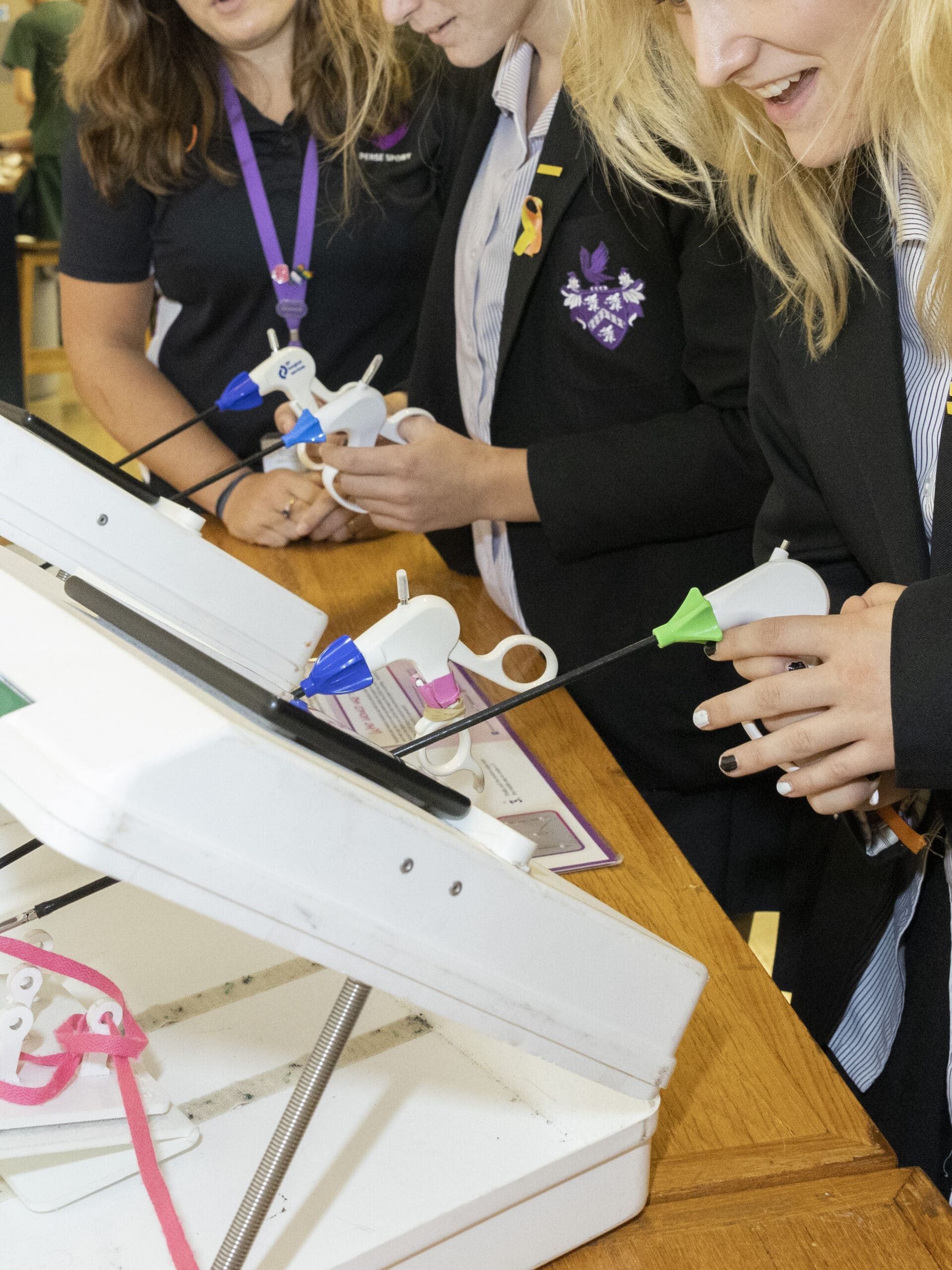
Physics encourages pupils to look beyond surface-level explanations and develop the confidence to work things out for themselves. Through the study of forces, energy, electricity, waves, space and the structure of matter, pupils learn how mathematical models help us understand the physical world. Practical investigation lies at the heart of the subject, giving pupils regular opportunities to design experiments, analyse evidence and develop the hands-on skills that are central to scientific enquiry.
Throughout their Physics education at The Perse, pupils develop logical reasoning, resilience and problem-solving skills that support success not only in science, but across a wide range of academic disciplines.
Beyond the classroom
Physics extends well beyond lessons through a rich programme of clubs, lectures, competitions and enrichment opportunities. Lower School pupils can join Science Club and Lego Robotics Club, while older pupils benefit from extension Physics lessons, the Engineering Club, Aviation Club and pupil-led Physics Society.
Students regularly hear from leading scientists and engineers through the Perse 42 Society programme, attend Cambridge Physics Centre lectures at the Cavendish Laboratory, and take part in Science Live events. Many pupils also participate in the UK Space Design Competition, developing teamwork, creativity and engineering skills while applying their scientific knowledge to real-world challenges.
Educational visits bring Physics to life. Year 10 pupils attend the Physics at Work exhibition at Cambridge University’s Cavendish Laboratory, while older students benefit from further lectures and visits, including trips to Sizewell Nuclear Power Station.
Recent highlights
Perse physicists continue to achieve exceptional success nationally, with pupils earning 312 awards across six British Physics Olympiad competitions, including two Top Golds and 65 Golds. Thirteen Perse students from Years 10 to 13 were also part of the winning company in the national final of the UK Space Design Competition, while a Perse student produced the winning video in the Institute of Physics’ Quantum on the Clock competition.
The department is also proud of its distinguished alumni. In 2025, Old Persean Professor John Clarke was awarded the Nobel Prize in Physics, becoming the second Perse alumnus to receive the honour. He follows Sir George Paget Thomson, joint winner of the 1937 Nobel Prize for demonstrating the wave nature of electrons, continuing a remarkable tradition of Physics excellence associated with The Perse.