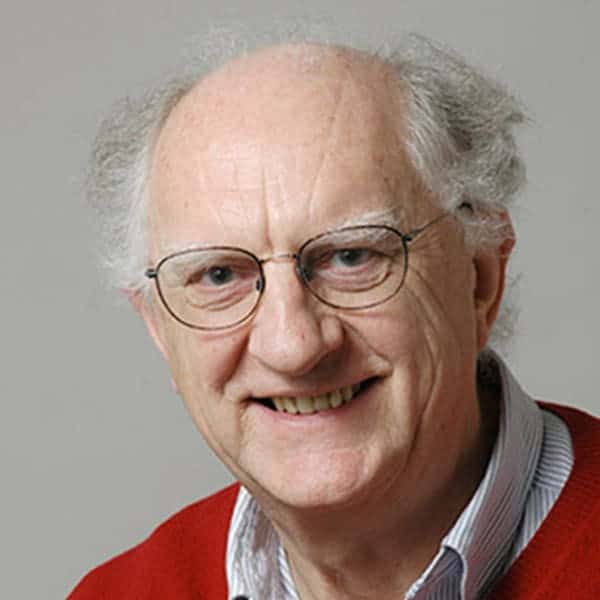
John Clarke
California-based Professor John Clarke is Professor of Experimental Physics at the University of California, Berkeley. A Professor in the Graduate School, his research concerns Condensed Matter Physics and Materials Science. In 2025, he was jointly awarded the Nobel Prize in Physics with Michel H. Devoret and John M. Martinis for the discovery of macroscopic quantum mechanical tunnelling and energy quantisation in an electric circuit.
Professor Clarke studied physics as an undergraduate and postgraduate at Cambridge University (Christ’s College and Darwin College), receiving his doctorate in 1968. After a postdoctoral fellowship at Berkeley, he joined the Physics faculty in 1969. He has made significant contributions to superconductivity.
Professor Clarke is a Fellow of the Royal Society of London, the American Physical Society, the American Association for the Advancement of Science, and the Institute of Physics (UK). He has been a Sloan Foundation Fellow, a Guggenheim Fellow and a Miller Professor.
He has made significant contributions to superconductivity and superconducting electronics, particularly in the development and application of superconducting quantum interference devices (SQUIDs), which are ultrasensitive detectors of magnetic flux. One current project is the application of SQUIDs configured as quantum-noise-limited amplifiers to search for the axion, a possible component of dark matter.
In 1987, he was named California Scientist of the Year and was awarded the Fritz London Prize for research in low-temperature physics. In 1998, he received the American Physical Society’s Joseph F. Keithley Award for Advances in Measurement Science and, in 1999, the National Academy of Sciences’ Comstock Prize for Physics. He was awarded the Hughes Medal of the Royal Society in 2004.