
Rouse Award: Innovative follow-spot light tracking system design

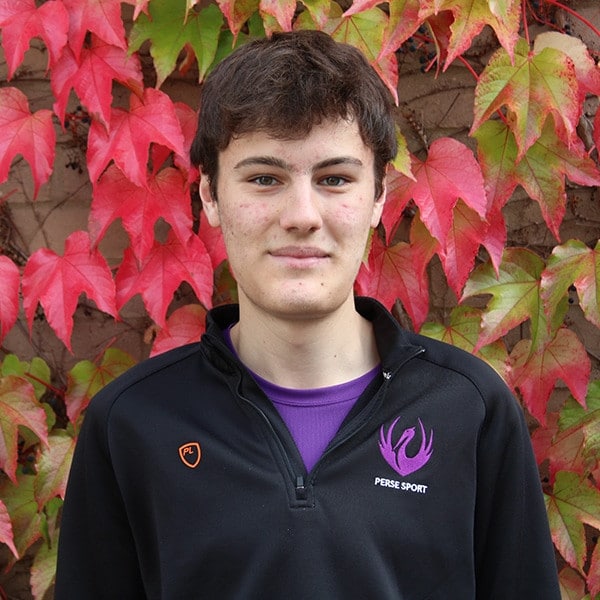
Oliver (Upper Sixth) designed and created an automatic follow-spot tracking system to win the Rouse Artefact Award.
As a member of the Perse Production Company, Oliver enjoys working behind the lighting desk at the school’s drama shows in the Peter Hall Performing Arts Centre (PAC).
For his Rouse project, he wished to combine his passion for technical theatre with his interests in computer science and electronics by building an automated follow-spot lighting system from readily available parts.
Oliver explained: “In the theatre you normally have follow spots, which are lights that are moved manually to follow someone around the stage, so you would use them if someone was doing a solo to focus on them.
“In the PAC we’ve got lights that move on their own, so from the lighting desk we can tell them where to point, but we don’t have anything that will follow the actors around the stage automatically.
“Such products exist on the market, but they cost many thousands of pounds. I’ve seen videos of these systems and they’re quite cool, but I thought ‘surely it could be made cheaper?’, so that’s where the idea for the project came from.”
Oliver began his investigation by looking at existing products to figure out how they worked and the technology used in their manufacture, before researching different positioning systems that allow the actor to be followed around the stage by the light.
He said: “You can go with just a camera and track the actor around the stage, but the issue is it’s unreliable and gets easily confused.
“With many systems, the actor has a tracker on them which has a chip that uses radio waves. There are three anchors around the side of the stage in known locations and what you can get is a distance reading from the anchors to the tracker.
“That information all goes back to a central server, which could be at the lighting desk, and calculates where the actor is.”
Oliver used commonly available components to build his prototype and was delighted with the outcome.
He said: “There was a lot of trial and error because the microchip I used was very small and very intricate and it’s not meant to be hand-soldered, so it was quite fiddly making sure all the connections went into it.
“I tested it at home and I was surprised with how effectively it worked, especially comparing the price of the parts I had to the actual systems on the market. Mine doesn’t have quite the reliability, but with more development it would.”
“I haven’t tried it in the PAC yet, but hopefully we’re going to use it in a small production coming up. It would be very satisfying to see it working in real life.
“It’s something I’d like to develop and I really think there’s a market for this, especially with smaller amateur theatres who might want to use something like this in a cost-effective way.”