Perse student earns prestigious award with Slinky research
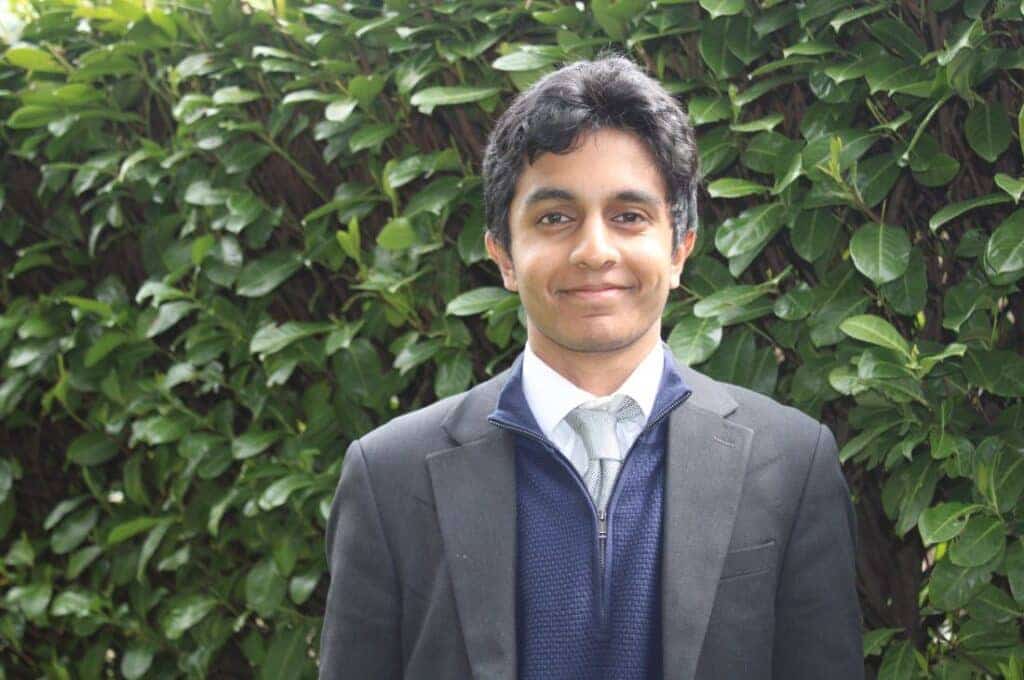
Dhruv (Lower Sixth) has a spring in his step after earning a Gold CREST Award for his investigation into the motion of a falling Slinky.
He had initially researched the topic as part of the British Physics Olympiad Experimental Challenge before adapting his project for the prestigious CREST Award scheme.
Dhruv spent time in the lab dropping a Slinky from a certain height by releasing it from a clamp and filming the process before assessing the position, velocity and acceleration at the top and bottom of the spring-based toy.
After researching papers on the subject, he began creating some programs to model what might happen.
He said: “My first model was quite elementary and it wasn’t that accurate because the physics behind this is really complex.
“However, I then took inspiration from another project carried out by a student from Georgia Tech and entered the variables needed from my Slinky, such as its mass, and that produced a pretty accurate model compared to what actually happened.”
Dhruv explained that accuracy and uncertainty had to be considered with the experiment, adding that the Slinky sometimes fell sideways after being released.
However, after filming a clean drop, he used Tracker software to transform the frame-by-frame footage into data he could analyse with Excel.
He said: “When you drop the Slinky, after its reached equilibrium, i.e. when it’s not moving any more, the top end moves down and the bottom end stays in the air stationary and then it all falls as one.
“One of the interesting things is that when you drop the Slinky, the acceleration at the top goes really quickly but then it decelerates when it meets the base, so it’s falling but slowing down at the same time, which is quite counterintuitive.”
After collecting his data, he put together his findings using scientific writing software LaTeX, as well as collating a log with an overview of the process.
He said: “I’m very happy to have got the Gold CREST Award. I really found it useful doing the scientific writing, as well as the programming to make the models.
“I want to be a physicist, and this was more like real physics where you’re doing it yourself and thinking about what’s going on rather than just following instructions.”