Perse student develops revolutionary science research program
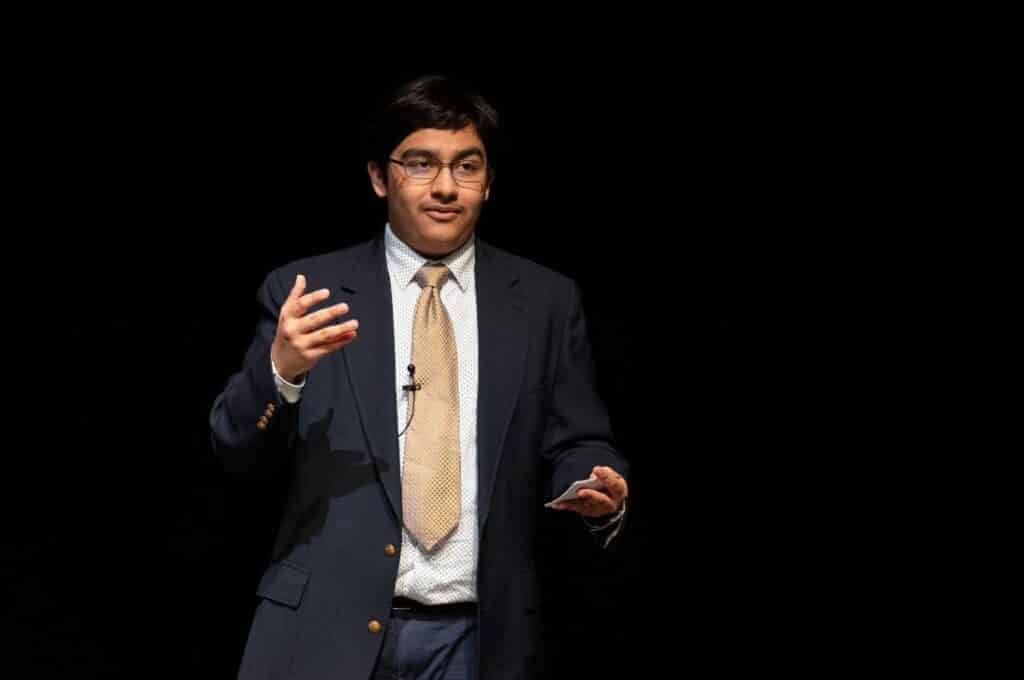
Neelkantha (Lower Sixth) has devised an innovative program to save scientists lots of time when researching online information.
He used the Python coding language to develop his WordMiner program, which allows researchers to sort through online databases much more rapidly, while using different filters to refine the process.
WordMiner was put to the test when Neelkantha joined up with his father Abir and Dr Randy Ballesteros at the Royal Veterinary College over Easter for their research into the genes affecting cellular proliferation.
Neelkantha said: “They sequenced the RNA of normal cells and aged cells to figure out which genes are expressed in the normal cells, but not the aged ones. Aged cells stop dividing so the genes which would be responsible for cellular growth would be downplayed.
“What would happen before the WordMiner program is that Dr Ballesteros would have to search every individual gene with any known links, which would be like digging into a mountain with a spoon!
“My thinking was maybe I could write a program to automatically search for them and that germinated the idea of WordMiner.”
The program works by consulting a chosen online database, by searching for a key word and a list of genes to be queried.
Neelkantha said: “The WordMiner program did it in roughly half an hour and it also ranks them by how many results there are, so it’s an indicator of how strong the links are.
“I referenced the list using the key word ‘mitosis’ (the process of cell division creating two identical cells) and that identified 1,235 genes out of an initial list of around 4,000, so I did a further filter with the key word ‘activin’ (a protein complex) that refined the list to 420 genes.
“Beyond that, Dr Ballesteros gave me some RNA sequencing data with known genes that were upregulated (sped up the process of cell division), so I consulted the list of 420 and from there, we found 20 target genes in the end.”
Their research was presented at the Endocrine Society’s ENDO 2024 conference in Boston last month, although Neelkantha was unable to attend as he was sitting a maths A level exam.
However, he will not miss out on a trip to the US city after being invited to join a research group by Dr J Carl Pallais at the Harvard Medical School-affiliated Brigham and Women’s Hospital next month.
Neelkantha said: “Dr Pallais saw my poster at the conference and thinks my WordMiner program might be useful in his own endocrinology-based research for figuring out links very quickly.
“As an aspiring medical student, I’m honoured and really excited for the opportunity to work with Dr Pallais.
“It’s great seeing the program taking effect with real work and I’m very happy to have been able to use my programming skills to address a question in basic bioscience research.”
In addition, the research abstract presented at ENDO 2024 will be published in the autumn volume of the Journal of the Endocrine Society.