Holocaust survivor gives poignant Perse Josef Behrmann Lecture


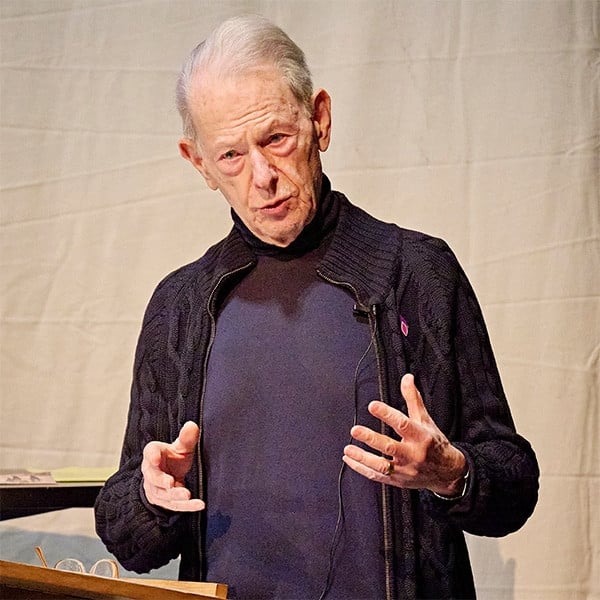
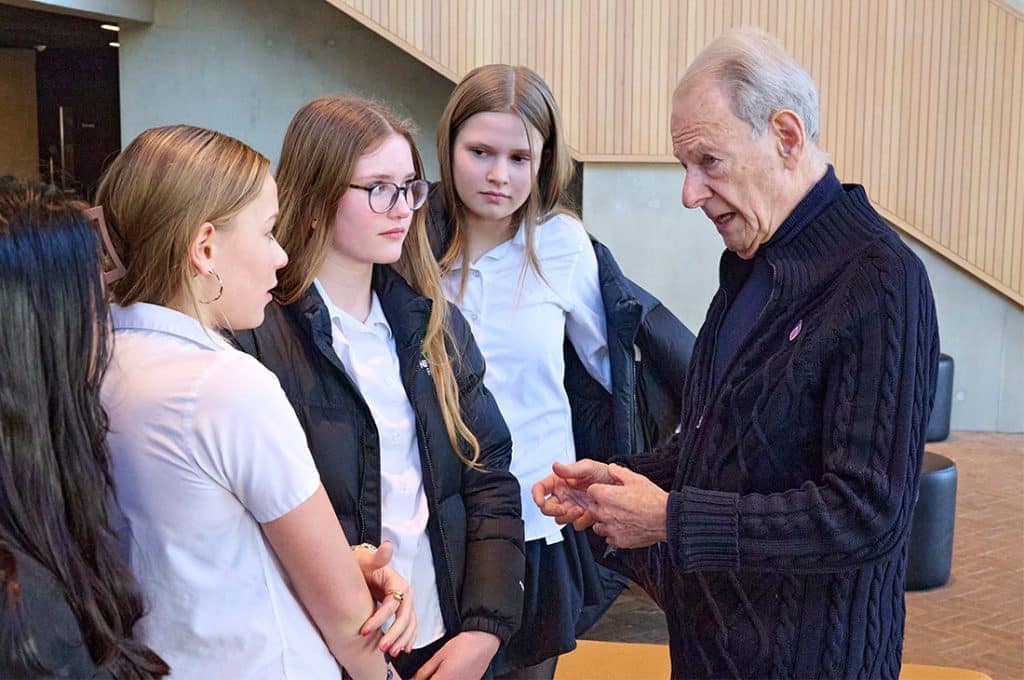
Holocaust survivor John Hajdu MBE gave a moving testimony of life as a Jew under both Nazi and Soviet regimes in this year’s Josef Behrmann Lecture at The Perse.
A packed Peter Hall Performing Arts Centre heard Mr Hajdu outline his turbulent experiences of growing up in Hungary in the annual talk, held in memory of Old Persean and Holocaust survivor Behrmann, who went on to become a Hollywood actor.
From shortly after his birth in Budapest in 1937, he explained how Jews became prohibited from running their own business, with their lives becoming increasingly restricted amid an air of growing antisemitism once Hungary allied with Nazi Germany in World War II in 1941.
Mr Hajdu recounted how his father was sent to a forced labour camp in 1943, leaving his mother to look after them both. The following year Jews were made to wear a yellow star and have the same symbol on the door of their house as marks of identification.
As their situation worsened, the Nazi-supporting Arrow Cross regime began rounding up Jewish men and women, with Mr Hajdu’s mother being sent to the Mauthausen concentration camp in Austria in October 1944.
Miraculously though, Mr Hajdu’s aunt grabbed him and they hid in a cupboard in a non-Jewish neighbour’s home – an act which he felt saved his life. However, on being discovered, they were moved into the Budapest ghetto, where Jews lived around 15 people per flat with little food to go around and were frequently attacked by Arrow Cross members.
With Russian troops advancing on the Nazi-occupied territory in early 1945, the siege of Budapest left the city in ruins and having nowhere to go, Mr Hajdu and his aunt discovered his father and uncle were now living in a Hungarian-speaking area of Romania and moved there.
Following her subsequent release from the concentration camp, his mother also eventually headed to Romania before returning to Budapest with John where life remained difficult for Jews under the new Soviet regime.


Unable to go to university, Mr Hajdu became a technical assistant on the state railway, but it was the failed revolution against the Communist government in 1956 that convinced him it was time to try to escape Hungary.
Mr Hajdu and his mother left with a small amount of food and his teddy bear, which he told the audience he still has sitting on his desk. They travelled by train to the final stop prior to the border before walking a further 20 miles over treacherous terrain to reach Austria, where they were then taken to a refugee camp near Innsbruck.
They subsequently queued outside the British Embassy in Vienna to seek permission to move to the UK and eventually settled in London in 1957 after spending time at a refugee camp in Staffordshire.
Thanks to the small amount of English he had learned as a youngster, at his mother’s insistence, Mr Hajdu was able to train in hotel management and catering, leading to him eventually becoming international sales manager for a major hotel chain.
In addition, he became a local magistrate and a pillar of his local community, as well as being awarded an MBE in 2020 for services to Holocaust education and commemoration due to his work in sharing his testimony with others on behalf of the Holocaust Education Trust and Holocaust Memorial Day Trust.
Mr Hajdu, who wrote an autobiography entitled Life in Two Countries as a way of telling his children and grandchildren his story, felt it was important to continue talking about the horrors of the Holocaust.
He told the audience: “What I went through is something I hope to speak to as many people as possible about. My aim is for you to think about what I saw and talk about it.
“I and other Holocaust survivors must make sure you understand the Holocaust was the most terrible thing that happened and it must never be forgotten. I’m living history standing in front of you, so I hope that message gets through.”