Sixth Form reflections from LSE Future Minds Economics Conference
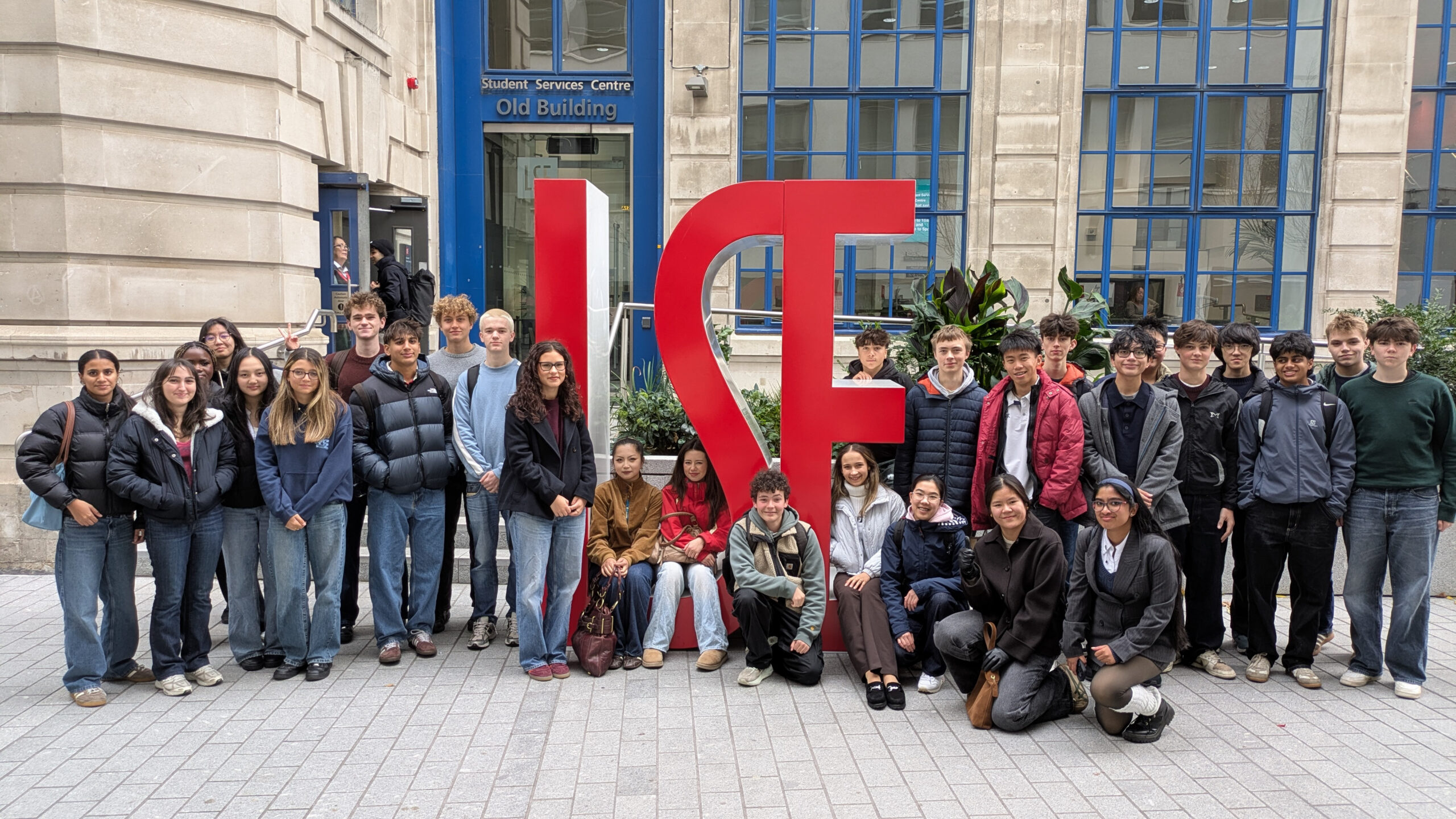
This month, 43 Lower Sixth economists attended the Future Minds Conference, hosted in partnership by LSE’s Hayek Programme and the Institute of Economic Affairs (IEA).
The conference explored topics including market failure, trade and economic growth, as well as the philosophy underpinning economics. Through a series of talks and panel discussions, pupils were encouraged to look beyond the curriculum, consider different perspectives and challenge some of the assumptions behind established economic theory.
Lower Sixth pupil Yoyo said the experience had prompted her to think more deeply about how she approaches the subject:
To me, attending the LSE Future Minds Economics Conference is more than an opportunity to listen to discussions about capitalism and economic growth. It has challenged me to think about how to approach economics: should we simply accept established economic theory or should we question the assumptions behind the theory?
One of the talks that particularly stood out to Yoyo came from Dr Bryan Cheang during the first panel, ‘Understanding Capitalism’. His discussion challenged the textbook approach to market failure and encouraged pupils to think critically about the economic models they encounter in their studies.
Yoyo reflected:
We often build our understanding of economics around the textbook theories, and treat them as the foundation of our thinking, despite knowing that the economic models represent our reality imperfectly. His argument reminds me that perhaps learning economics should not just involve understanding the established theories, but also questioning the assumption behind the theory.
The second panel, ‘Analysing Growth’, explored economic growth, with Yoyo particularly interested in the role of evidence when evaluating different arguments:
This made me reflect on the importance of differentiating between arguments that sound convincing and those supported by concrete evidence. In economics, where opinions can be persuasive, data is crucial in testing whether our assumptions are actually valid.
Other pupils also came away reflecting on their own perspectives. Rose said the talks “made her consider the rationale for her initial perspective”, while Chrysalis said they made her “think critically about what I’m learning in lessons”.
The discussions left pupils considering not only the economic ideas they study, but some of the wider questions surrounding how economies work and who they serve. Yoyo concluded:
Economics is not just about understanding how the world works, but also thinking about how we can better allocate resources for the benefit of the people now and future generations.
Reflecting on the conference, Mr Larner, Head of Economics, said:
It was a really good day, with some genuinely challenging and thought-provoking ideas being shared. The conference took us well beyond the curriculum, encouraging students to explore not just the economic ideas they meet in textbooks, but why we think about economics in particular ways and the different ideologies that sit behind the subject.
Hearing a forthright free-market perspective from the IEA and LSE’s Hayek Programme gave students something distinctive to engage with. The speakers were excellent at conveying their arguments, while also encouraging students to debate and challenge them. A few feathers were ruffled at times, but that was exactly what sparked some of the best discussion and reflection.